Allocation Meets Location
The account is part of the plan.
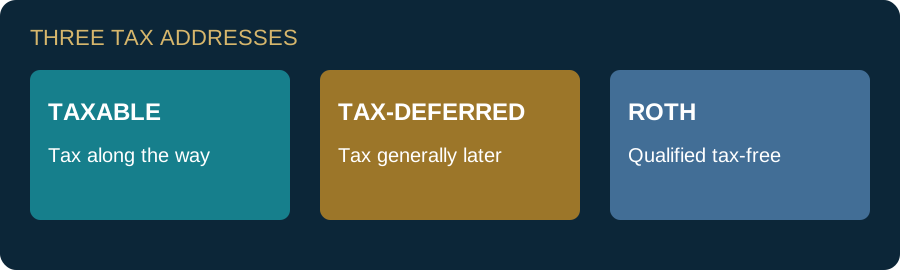
You may know how much of your portfolio is invested in stocks, bonds and cash. But do you know which tax rules apply to each dollar, and when you can actually use it?
Allocation describes the investments you own. Location describes the accounts holding them. A stock fund can be held in a taxable brokerage account or, where available, inside a traditional IRA or Roth IRA. The investment risk may be similar; the tax consequences can be very different.
Account names such as IRA and 401(k) may sound familiar. Familiarity does not explain what belongs where. Start with three broad tax categories, then ask how much you can afford to commit to each.
What better coordination can do for you
Keep the business resilient. Protect operating cash before chasing a deduction.
Keep more choices open. Match near-term access and long-term tax treatment to each goal.
Measure the real benefit. Compare current tax savings with future taxes, employee costs and fees.
Follow the tax journey
| Tax address | Money going in | While invested | Money coming out |
|---|---|---|---|
| Taxable | Usually after-tax money. No deduction just for investing. | Interest, dividends and realized gains can be taxable. Unsold gains generally defer tax. | Return of tax basis generally is not taxed again. Realized gains may be taxable. |
| Tax-deferred | Eligible pretax or deductible contributions may lower current taxable income. | Investment activity generally does not create current income tax inside the account. | Pretax money and earnings generally face ordinary income tax. After-tax basis changes the calculation. |
| Roth | After-tax contributions; no current deduction. Conversions can create tax. | No annual tax on investment income within the account. | Qualified withdrawals are federally tax-free. Nonqualified withdrawals have separate rules. |
These are account rules, not promises about returns. A bank savings account holds deposits; a brokerage account may hold securities and brokered CDs. Workplace plans may offer a limited menu. Not every account can hold every investment.
In taxable accounts, ordinary interest, qualified dividends and long-term capital gains may face different rates. A retirement account generally does not preserve the capital-gains rate on pretax withdrawals. The account’s location can therefore matter even when the holdings look alike.
How does money get there?
New saving
IRA contributions generally require eligible compensation, subject to limits; a qualifying spousal IRA contribution may be possible. Workplace salary deferrals come through an eligible employer plan. Employer contributions follow plan and compensation rules. Direct Roth IRA contributions may be income-limited.
Moving existing retirement money
An eligible rollover or direct transfer moves existing retirement savings. It is not a new annual contribution allowance. The receiving account or plan must be eligible and willing to accept it; not all payments can be rolled over. SIMPLE IRA and other special rules can restrict transfers.
Changing the tax treatment
Converting eligible pretax savings to Roth generally creates taxable income on previously untaxed amounts. A conversion is not a tax-free shortcut. Timing, basis, withholding and payment of the tax bill deserve professional review.
Contribution limits are not account balances
For new retirement saving, limits depend on the account or plan, compensation, age and applicable rules. Traditional and Roth IRA contributions share an annual limit. Employee deferrals across applicable workplace plans and employer/employee totals may also be subject to combined limits. You cannot simply add every advertised maximum together.
An ordinary taxable account generally has no federal retirement-contribution ceiling. That does not mean the household can afford to invest unlimited money. Spending needs, debt, reserves and business working capital still come first in the planning discussion.
The business-owner toolbox
Traditional IRA
Personal-scale annual allowance.
Individual; deductibility can depend on income and workplace coverage. Comparatively simple administration.
SIMPLE IRA
Generally above IRA capacity; employer support added.
For eligible small employers; employee deferrals and employer contributions. Eligibility, employee coverage and restrictions apply.
401(k) / safe harbor
Generally higher deferral capacity; employer funding can add more.
Salary deferrals plus optional or required employer funding. Safe harbor is a design, not a separate limitless bucket; required employer contributions for eligible employees and other conditions apply.
Profit-sharing
Employer capacity within defined-contribution limits.
Employer allocation under plan rules; discretionary funding can add to a 401(k), but combined limits, employee coverage and nondiscrimination rules matter.
Cash-balance pension
Potentially substantial; individually actuarially determined.
Employer-funded defined-benefit plan. Capacity depends on age, pay and promised benefits; actuarial costs and ongoing funding obligations apply.
This is a relative planning map, not a ranked recommendation or a statement of dollar limits. A cash-balance pension may complement a 401(k)/profit-sharing arrangement, but combined-plan deduction and coverage rules require specialist analysis. Availability, costs and requirements differ. Some plans may offer Roth features; traditional pretax treatment is not the only possible design.
How much belongs where?
Protect access. Separate money needed soon from money that can remain invested. Liquid taxable deposits may suit near-term needs; check deposit insurance and coverage limits. A money-market fund is not an insured bank deposit.
Compare today with later. A current deduction may be valuable, but future withdrawal taxes matter too. Roth treatment trades a deduction now for potential qualified tax-free withdrawals later. Future tax rates are uncertain.
Coordinate the whole household. Taxable, tax-deferred and Roth balances can offer different withdrawal choices. There is no required three-way split. Risk, fees, beneficiaries and tax circumstances matter alongside the account labels.
For owners, model the full cost. A larger deductible contribution may help a business owner, but employee funding, administration, pension commitments and working capital must be included. Ask what is sustainable, not merely what is allowed.
A $100,000 decision
A successful owner, a real trade-off
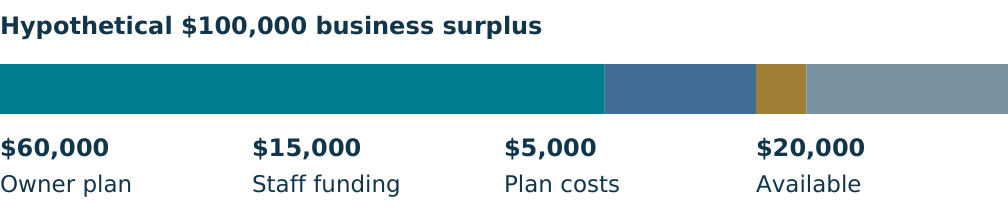
Consider a hypothetical owner whose profitable firm can commit $100,000 after wages, operating needs, debt service and reserves. Her existing retirement plan and compensation support an additional $60,000 deductible employer contribution allocated to her account, plus $15,000 for eligible employees and $5,000 in incremental plan costs. These are assumptions, not contribution limits or a typical plan quote.
The cash-flow arithmetic
$60,000 + $15,000 + $5,000 = $80,000 committed, leaving $20,000 of the original surplus available. Assume the full $80,000 is deductible and reduces income otherwise taxed at an effective 32% marginal rate. The illustrative current federal income-tax reduction is $25,600; the after-tax economic cost is $54,400.
What the owner actually gains
She moves $60,000 into her retirement account, funds employees and retains $20,000 of uncommitted cash. That is a planning benefit, not $25,600 of free money: pretax retirement withdrawals generally remain taxable. The tax benefit may arrive later than the cash outlay.
When this example stops working
If cash flow is uneven, employee costs are higher or funding must continue in a weak year, a smaller commitment may be wiser. Actual deductions, contribution capacity, compensation, plan coverage, the qualified-business-income deduction, state taxes and pension rules can change the result. Obtain a plan illustration and tax projection before acting.
Follow the household dollars
Original workbook page 16: figures in thousands of dollars.
| Account ($000s) | Reserve | Fixed | Core | Growth | Total |
|---|---|---|---|---|---|
| His pretax IRA | 0 | 150 | 50 | 50 | 250 |
| Her pretax IRA | 0 | 100 | 50 | 0 | 150 |
| Joint taxable | 150 | 0 | 400 | 50 | 600 |
| Household | 150 | 250 | 500 | 100 | 1,000 |
Same allocation. Different tax addresses.
This exact hypothetical map comes from the original 28-page workbook, page 16. Each row preserves an account’s ownership and balance; each column totals a portfolio job. The household is still 15% reserve, 25% fixed annuity, 50% equity core and 10% growth. Moving a holding’s tax address is not the same decision as changing total investment exposure.
Why consider this arrangement?
The illustration puts accessible spending reserves in the taxable account and ordinary-income-heavy fixed holdings inside pretax IRAs. Low-turnover equities may fit taxable accounts, but dividends, turnover, capital-gains rates, foreign tax credits and charitable plans can change the answer. An annuity in an IRA adds no separate tax-deferral advantage; any rationale must rest on the contract’s insurance features and trade-offs.
What must stay separate?
The example assumes both IRAs are fully pretax and includes no Roth balance. Each spouse’s required distributions and liquidity must be assessed separately; their IRAs cannot be pooled to satisfy one owner’s RMD. Implementation would require appropriate transfers, not an unnecessary taxable cash-out. Existing cost basis, embedded gains, surrender terms and transaction costs must be reviewed before any change.
Access rules deserve their own review
Retirement accounts are not unrestricted short-term cash buckets. Early withdrawals may trigger tax or penalties, and workplace plan access rules apply. Roth IRA regular contributions generally come out first, but earnings and conversions have separate rules. Qualified Roth IRA earnings generally require a five-tax-year period plus age 59½ or another qualifying condition. Traditional accounts generally have later required distributions; Roth IRAs have no lifetime RMD for the original owner. Beneficiary rules differ.