Even a Monkey Can Get Lucky

START WITH YOUR LIFE, NOT A PRODUCT
The monkey has a winning streak. Should it get your retirement?
Imagine opening a statement and discovering that a dartboard beat your carefully selected investments. The monkey on the cover looks smug. Your next question should not be where to buy bananas in bulk.
It should be: what exactly did the contest measure? A lucky result over one interval does not establish a repeatable process. Nor does a professional title guarantee success. Comparisons change when risk, fees, taxes, selection rules and the full record enter the picture.
The satire has a serious point. Retirement is not a contest to produce the best cocktail-party story. An investor needs a process that can be explained, monitored and connected to personal goals, even when another portfolio briefly grabs the spotlight.
Imagine a monkey in a necktie announcing his latest investment triumph.
“My proprietary process combines advanced banana analytics with throwing something at the wall.”
His stock went up. He is now available for television interviews.
That monkey is fictional. The investing debate behind him is very real. For decades, researchers and journalists have asked an uncomfortable question: how much of a successful stock pick comes from skill, and how much comes from simply being in the right place at the right time?
First, nobody recommended hiring a monkey
In his 1973 book A Random Walk Down Wall Street, economist Burton Malkiel used a dart-throwing monkey to challenge the idea that experts can reliably select winning stocks. His practical recommendation was broad diversification through index investing, not a trip to the zoo. He made that distinction explicit in a 2003 interview.
Which is fortunate. The compliance paperwork for a chimpanzee would be exhausting.
Then the newspaper brought out the darts
The Wall Street Journal launched its famous contest in 1988, comparing professionals’ stock selections with stocks chosen by people throwing darts. Human beings supplied the throwing arms. The monkeys remained a metaphor.
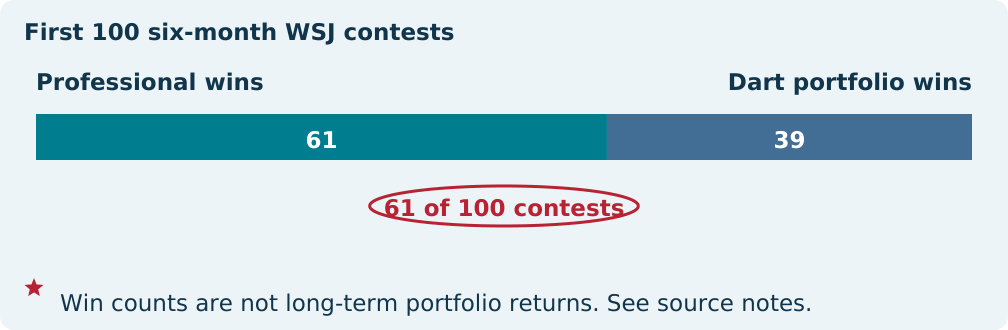
The result was less convenient than either side’s favorite headline. After the first 100 contests under the later six-month format, the professionals had won 61 and the darts 39. Professionals won more often, but random selections still beat them surprisingly often. Contest history and results.
At the contest’s 2002 conclusion, reporting showed that the professionals also led on average returns. But the Journal’s reporter cautioned that this was entertainment and idea generation, not a scientific test. Malkiel argued that publicity surrounding the professionals’ picks affected the comparison. Contemporary reporting.
So “monkeys always beat the experts” is a great headline. It is a lousy summary.
Eventually, the monkeys got computers
In 2013, researchers at Cass Business School, now Bayes, described simulations using U.S. stock data from 1968–2011. They created millions of randomly weighted portfolios and found that nearly all beat their market-cap-weighted comparison over the full historical period. These were computer simulations, not millions of actual monkeys opening brokerage accounts. Bayes research summary.
Crucially, this compared ways of building an index. It did not establish that random picks beat every professional, every year.
A separate 2013 paper found that randomly constructed portfolios could pick up greater exposure to smaller companies and value stocks, helping explain historical results before transaction costs. Different portfolios carry different risks; a clever backtest does not promise a repeat performance. CFA Institute research digest.
The monkey may have stumbled into a different investment strategy. He did not necessarily discover tomorrow’s winners.
What should a human investor do with this?
Before crowning yourself, your neighbor or a television personality the next investing genius, ask:
- Compared with what? A booming market can make many stock picks look brilliant.
- At what risk? A concentrated bet can produce an impressive gain and an equally impressive loss.
- After what costs? Fees, trading expenses and taxes affect what you actually keep.
- Where are the failures? Hearing only about the surviving winners makes any strategy look better.
- Does it fit my life? A stock-picking contest does not know when you need retirement income or how much loss you can withstand.
A good financial conversation should address those questions, along with cash needs, diversification, withdrawals and a plan for difficult markets. It should not depend on someone predicting the next hot stock.
Keep the monkey for comic relief. Your retirement deserves more than a lucky throw.
Educational commentary and satire. The necktie-wearing monkey is fictional. Historical contests and simulations have limitations and are not recommendations. Investing involves risk, including loss of principal. Diversification does not guarantee a profit or prevent loss; past performance does not guarantee future results.
A CLOSER LOOK
The scoreboard is only the beginning
A lucky pick is entertaining. A repeatable process must survive many decisions, changing markets and real-world costs. The monkey story is useful when it makes us ask better questions, rather than decide that skill never exists or that luck can fund a retirement.
★ Circle 61: professionals won more often in this early sample. Circle 39 too: random picks won many rounds. This is a contest win count, not the return on one continuously held portfolio or a test of every advisor's value.
The coordination gap
One account buys a hot industry fund while the business and another account depend on the same industry. Each choice looks reasonable in isolation. The combined exposure tells a different story. Someone must look at the whole picture, not just the winning ticker.
Questions worth bringing to your professionals
- What risk was taken to produce the result?
- Are losing attempts included, and are fees considered?
- Does the strategy fit the investor's cash needs and broader holdings?
The 61/39 figures refer to the cited first 100 six-month WSJ contests, not all later experiments. The original article's source notes explain the different methods and limitations.
What a thoughtful review could help you do
- Distinguish a memorable winner from evidence of repeatable skill.
- Ask how much risk and cost sat behind the headline result.
- Judge a portfolio by its job rather than by a single lucky rival.
A practical next step
Ask for results over relevant periods, net of the applicable costs, with a suitable comparison and an explanation of risk. A persuasive story should survive those questions.
These are planning opportunities, not promised outcomes.