The Pac-Man Problem
Who is helping you manage the whole business as an asset?
The Pac-Man Problem
An oil change can turn into a much bigger conversation. In this fictional story, a financial advisor with the Certified Exit Planning Advisor (CEPA) designation asks the shop owner whether he works with an advisor.
“Yes. A friend has been helping me with my IRA for years.”
“Good,” the advisor replies. “Who is helping you manage the business itself as a financial asset? Who is helping you understand what a buyer could pay for it without you?”
The owner pauses. “What do you mean?”

Imagine your financial life as a Pac-Man-shaped circle. The small wedge represents the investment accounts that receive regular attention. The larger body may be the business: your income engine, a potential retirement asset and part of your legacy. Actual wealth proportions differ.
A good IRA relationship is valuable. The opportunity is to see the whole circle. The business-owner survey at the end helps you identify what you know, what is uncertain and where a coordinated conversation could begin.
Good specialists. One coordinated plan.
Close the gaps between good advice
You may have excellent professionals and still have gaps between them. A tax decision can affect cash flow. A loan can constrain an ownership transfer. An insurance contract may not match the buy-sell agreement. A retirement plan can quietly depend on sale proceeds nobody has assessed.
Give someone responsibility for coordination
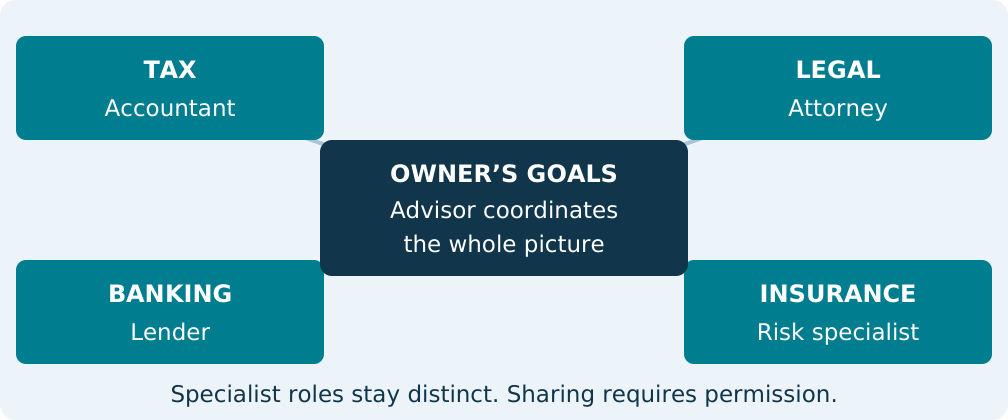
A financial advisor who understands business owners can serve as a quarterback: clarify goals, invite the right specialists with your permission, align assumptions and keep next steps visible. The quarterback does not replace the accountant, attorney, banker or insurance professional, or provide services beyond their qualifications.
Make each specialist’s job clear
Before a potential sale, the valuation specialist examines the business; the accountant models taxes; the attorney reviews ownership and deal terms; the banker reviews debt and financing; insurance specialists assess risks; the financial advisor tests how possible net proceeds fit your spending and family goals.
The owner should know what needs attention, who owns the next step and why it matters. That is more useful than five separate reports built on different assumptions.
Value is more than this year’s sales.
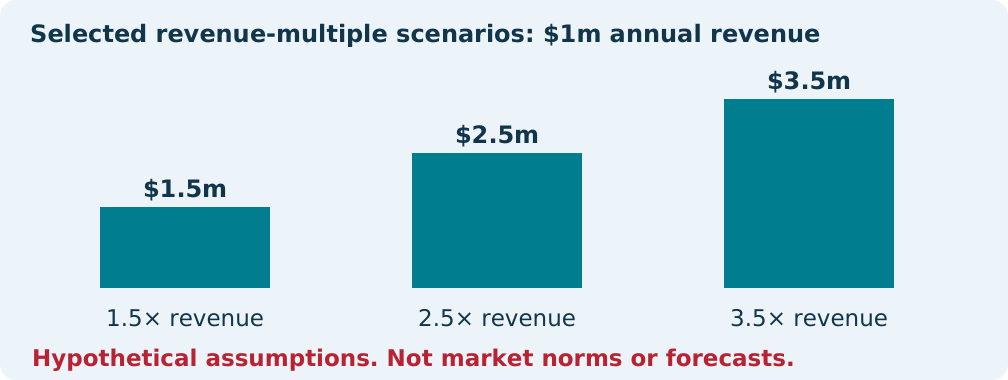
For illustration, hold annual revenue at $1 million. At an assumed 1.5× revenue multiple, enterprise value is $1.5 million. At assumed 2.5×–3.5× multiples, it is $2.5 million–$3.5 million: a hypothetical $1 million–$2 million difference before adjustments.
A calculation, not a valuation
These selected multiples are hypothetical, not industry benchmarks or expected outcomes. They show the arithmetic of a possible improvement from 1.5× to 2.5×–3.5×. Multiples can fall as well as rise.
Use the right measure
Revenue is not profit. Many businesses are valued on normalized earnings, EBITDA or seller’s discretionary earnings, not revenue. Never substitute one denominator for another. Industry, margins, size, risk, buyer demand and deal structure matter; a qualified valuation is needed.
Separate the headline from your proceeds
Enterprise value is not your retirement deposit. Debt, cash adjustments, taxes, transaction costs and contingent or deferred payments affect what you actually receive. Improvement costs money and takes time. A higher valuation or completed sale is never assured.
Profit is not the same as freedom.
Imagine a hypothetical owner with $1 million in annual revenue and $200,000 of operating profit before a replacement manager. The firm pays well, but the owner approves every quote and its largest customer generates 40% of revenue. This is a fictional example, not a client result.
Buy back time before assuming a bigger sale
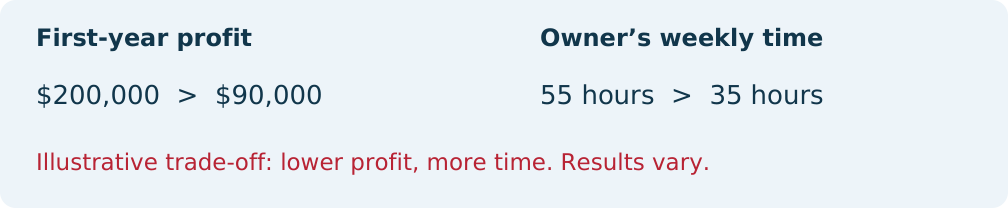
She invests $30,000 in process documentation and training and hires a manager for $80,000 a year, including benefits. With revenue and all other costs unchanged, first-year operating profit falls to $90,000; after the one-time project, it is $120,000 a year. Transition costs and execution risks may be greater.
Define success in observable terms
For this idealized example, she moves from 55 to 35 working hours a week and the team successfully handles a two-week absence. That is 20 hours regained per week, not proof of a higher valuation. She tests service quality, cash flow and retention before stepping back further.
Then test transferable value
Cleaner records, broader customer relationships and reliable management may make the company easier to operate and evaluate. A valuation professional must assess whether those benefits outweigh the lower earnings. The 2.5×–3.5× scenarios are not outcomes promised by this example.
Benefits worth pursuing even if you never sell
Less dependence on your daily decisions. Clearer financial information. More time and a wider choice of when, how or whether to transition. Improvements must still earn their cost.
Build an asset that can work without you.
A fresh coat of paint improves presentation. A real renovation strengthens what lies underneath. For your business, that means repeatable results, visible risks and success that does not depend on one person.

Discover: agree on the starting point
EPI’s Value Acceleration Methodology connects business, personal and financial goals. Ask what the business could transfer today, what you need from it and where the gap lies.
Prepare: improve and test
Review its four intangible capitals: human (people), social (culture and relationships), structural (systems) and customer. Develop managers, document processes, clean up records and reduce concentration. Test a handover rather than assuming it will work.
Decide: keep building or pursue a transition
Revisit readiness and costs with your team. A stronger business can offer better control, fewer surprises and more options, but neither a higher multiple nor a completed sale is assured.
Ask for one concrete next step
“How are we managing my business as an asset, who is measuring its transferable value, and what should we work on next?” Assign an owner and a review date to the answer.
Put your own business in the picture.
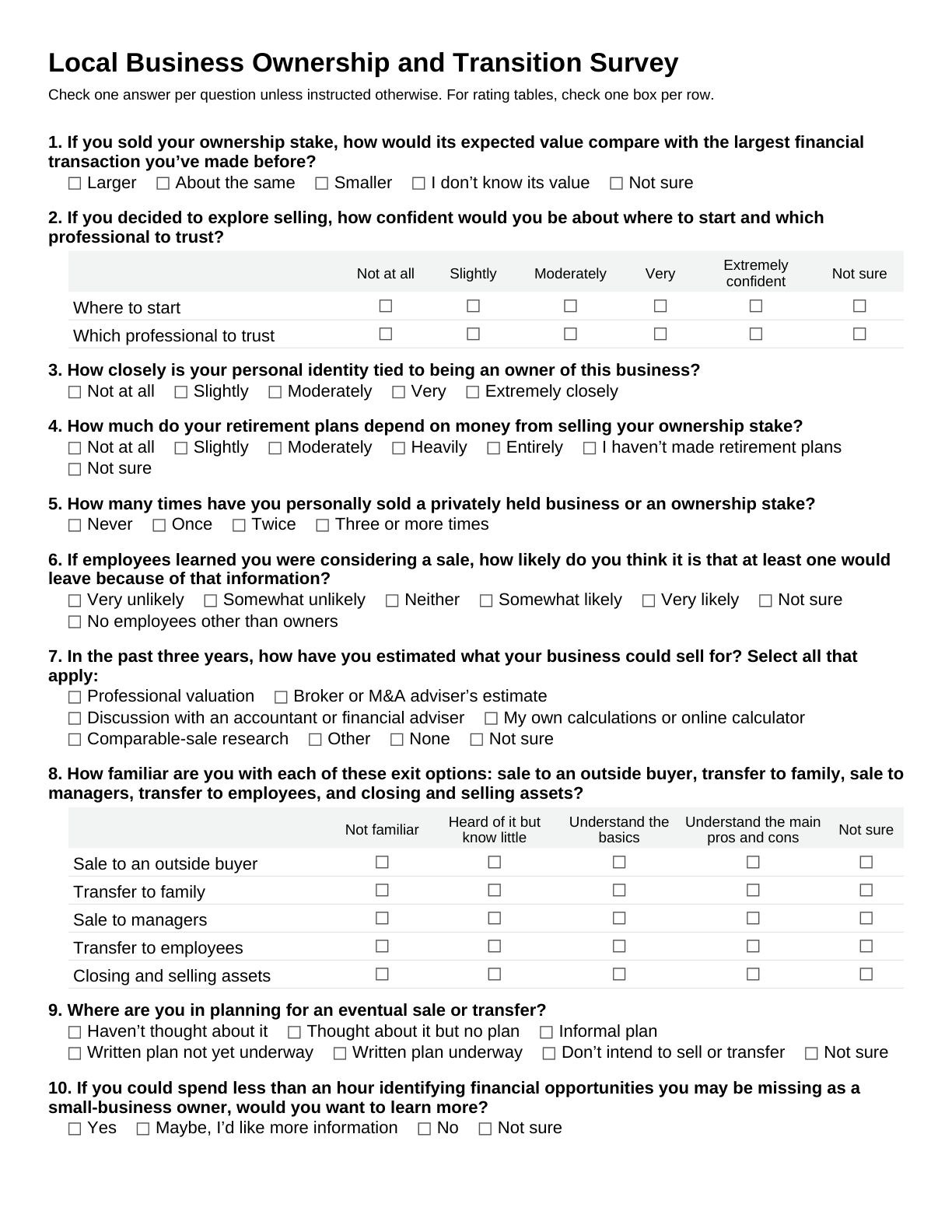
Start with the survey on the next page
The shop owner began with an IRA. He ended with a larger question: who is helping him prepare the business that may fund his future? Before anyone proposes an answer for you, the attached Local Business Ownership and Transition Survey gives you a place to start.
Connect the story to your situation
The ten questions ask about your business value, confidence in finding help, identity as an owner, reliance on sale proceeds and experience with a sale. They also explore employee concerns, valuation work, transition options and the planning you have already done.
A “not sure” can be your most useful answer
Complete the survey honestly, whether a transition is near or years away. Follow its answer instructions. There is no score, diagnosis or implied recommendation. The purpose is to make uncertainty visible before it becomes a decision made under pressure.
Turn answers into a coordinated conversation
Review your answers with your chosen financial, tax, legal or business-valuation professionals. Ask: What needs evidence? Which professional should help? What is the next step? Your answers can guide that conversation; they do not establish the value of your business or determine a strategy.
Print the next page or save the PDF and use its existing checkboxes in a compatible PDF reader. Keep your completed copy for your own review. This article does not submit or collect survey answers.
Your next step: the business-owner survey
Complete the attached ten-question survey to prepare for a conversation with your chosen professionals. Your answers stay in your saved PDF or printed copy; this page does not collect them.