A Better Pilot. Not a Crystal Ball.
A Better Pilot. Not a Crystal Ball.
Why the value of advice may show up in the decisions you do not make.
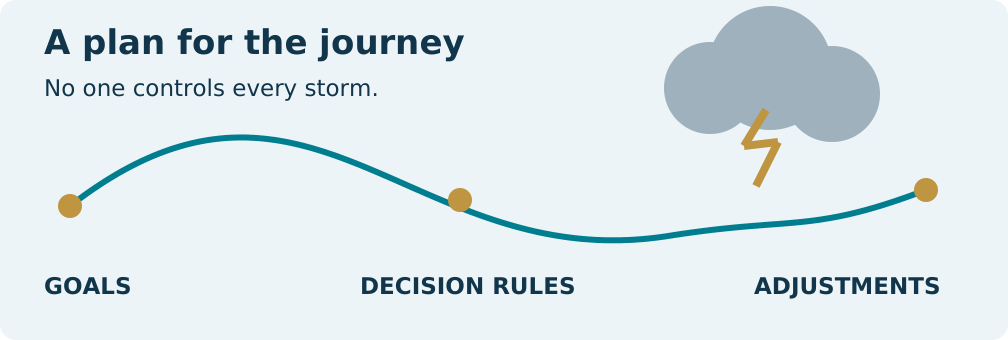
THE BREAKFAST-TABLE EMERGENCY
Dan has built a profitable service business. He can diagnose a rattling engine by ear. At breakfast, though, a red market ticker turns him into a man convinced he can diagnose the entire world economy before his coffee cools.
“Sell it all,” he tells his wife. “We’ll get back in when things settle down.” She asks the one question his television has not answered: “When, exactly, will that be?”
This fictional couple needs more than another prediction. They need to know which money pays the bills, how much loss they can withstand and what would genuinely justify changing their plan. A thoughtful advisor helps turn a frightening headline into a structured conversation.
What you may gain
Perspective: separate a changed goal from a changed mood. Discipline: make decisions with rules rather than adrenaline. Coordination: connect investments, taxes, cash needs and family priorities.
The question worth asking
Can your plan remain workable when the news is ugly, the market is exciting, or life changes? Beating a stock index is a poor substitute for being able to fund the life you actually want.
What Vanguard actually says.
A research framework, not a return coupon.
THE NUMBER NEEDS ITS FOOTNOTE
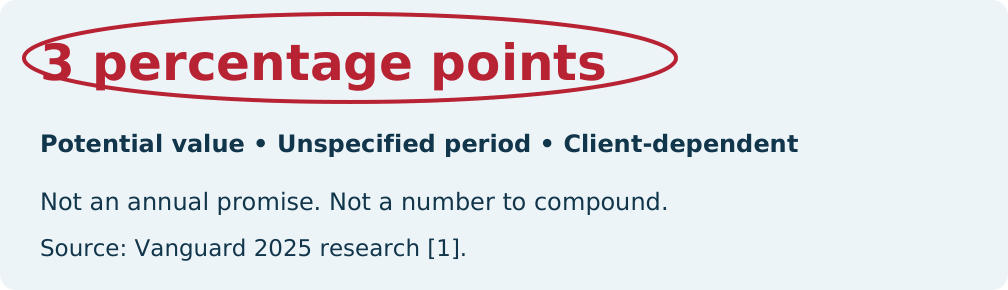
Vanguard’s 2025 anniversary research, reflecting its 2024 quantification update, estimates that applying wealth-management best practices can potentially add up to, or even exceed, 3 percentage points in net returns. It explicitly describes an unspecified period, with results varying by client circumstances. It is not a guaranteed extra 3% each year. [1]
The framework considers allocation, investment selection, rebalancing, behavioral coaching, asset location, tax-efficient retirement strategy, total-return investing and tax-loss harvesting. The component estimates cannot simply be added into a promised return. Opportunities overlap and do not all apply to every account. [1]
Where the value can show up
Helping someone avoid an unsuitable decision during panic or euphoria can matter greatly. Cost and tax work can also help, but outcomes depend on implementation, fees, account types and the starting situation. Research on potential value does not prove that every advisor delivers it.
A broader scorecard
Vanguard’s December 2025 research describes four dimensions: portfolio, financial planning, emotional and time value. Its investor survey found peace of mind was the most frequently cited reason for seeking advice. These are reported perceptions, not proof of higher returns. [2]
Keep the standard high
Ask for the services you will receive, the complete cost, conflicts of interest and how progress will be evaluated. A calm voice is valuable only when it accompanies competent, appropriate work.
The sale that needed a sequel.
Behavioral story 1: relief now can create a harder decision later.
THE CASH PARKING LOT
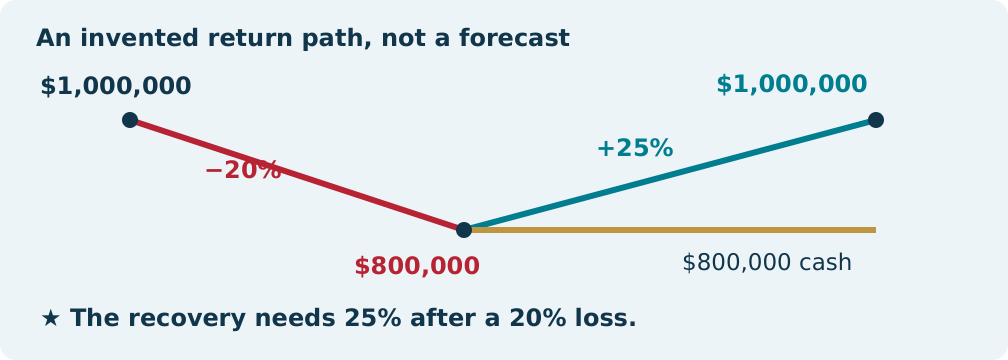
Imagine Dan has $1,000,000 in a hypothetical portfolio. It falls 20% to $800,000. He sells and waits for “certainty.” Over the next illustrated period the original portfolio rises 25%. It is back at $1,000,000, while his cash remains $800,000 under our assumed zero cash return.
Read the gap correctly
The $200,000 difference comes entirely from this invented sequence. It is not a measured advisor benefit. Cash may earn interest; taxes, fees and withdrawals are omitted. Markets could fall further, recover slowly or fail to recover within the investor’s time horizon.
What a useful conversation sounds like
“Which expenses must this money cover? Has your ability to take risk changed? Was the original allocation too aggressive? What is our re-entry rule if we sell?” Those questions make the decision deliberate. Staying invested at any cost is not a universal answer.
Why our brains make this difficult
Loss aversion can make a loss feel more urgent than a comparable gain feels rewarding. Recency bias can make the latest bad week feel like a permanent forecast. The news offers a new reason to worry every day; a plan needs a reason to act.
Potential benefit
An agreed decision process may reduce impulsive all-or-nothing moves. Sometimes the right outcome is a measured risk reduction, not a pep talk to hold everything.
The barbecue stock tip.
Behavioral story 2: the hottest story can quietly change your risk.
THE NEIGHBOR HAS A NEW BOAT
A neighbor credits one spectacular stock for his new boat. He says little about taxes, debt, earlier losses or whether he has sold anything. Dan hears “opportunity.” His wife hears “we are about to buy a boat for someone else.”
The napkin test
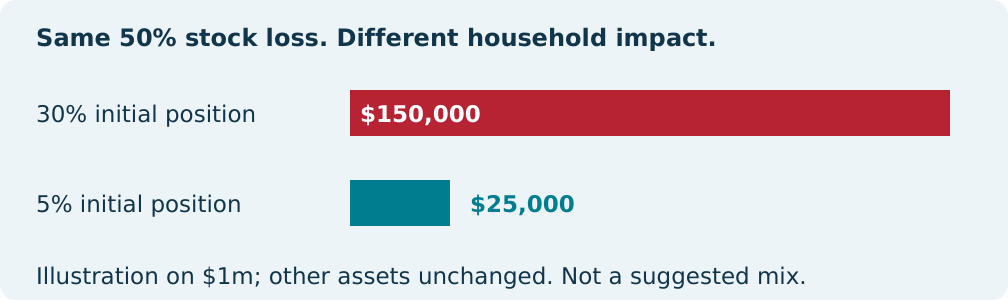
Suppose a $1,000,000 portfolio commits $300,000 to the exciting stock. A 50% decline in that holding costs $150,000, or 15% of the original total, assuming everything else is unchanged. At a $50,000 position, the same assumed decline costs $25,000, or 2.5% of the total.
Neither amount is a recommended allocation. A stock can lose more than 50%, including all its value. The point is to translate an attractive story into a loss the household can understand. Concentration can magnify gains as well as losses.
Trade a prediction for a boundary
An advisor can help examine concentration across the household, set an appropriate risk budget and agree when to rebalance. Rebalancing itself can generate taxes and costs. A process does not require correctly predicting next month’s winning stock.
A quieter benefit worth counting
For a separate $1,000,000 illustration, reducing comparable investment expenses from 0.80% to 0.20% saves $6,000 in the first year on an unchanged balance. That excludes advisory fees, trading and taxes; it is not a total net benefit or a reason to choose the cheapest product regardless of suitability.
Plan for changing weather.
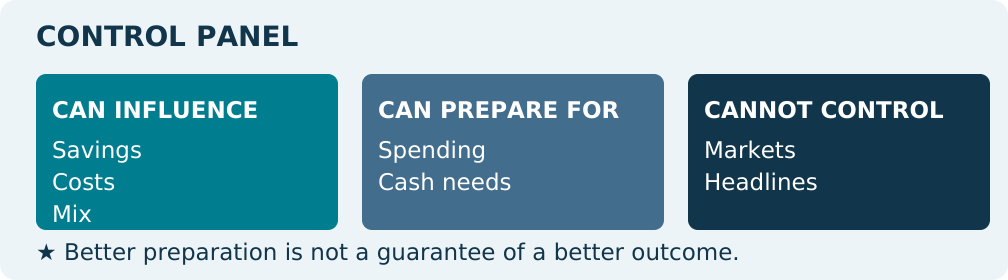
Probabilities help us prepare. They do not tell us what must happen.
THE 85% MISUNDERSTANDING
If a retirement model succeeds in 850 of 1,000 simulated paths, its reported success rate is 85% under those assumptions and that definition of success. It does not mean a real family is guaranteed an 85% chance of happiness, or that returns will be smooth.
Ask what breaks the plan
What if retirement lasts longer or poor returns arrive early? Does failure mean reduced spending or depleted assets? Testing alternatives can be more useful than admiring one percentage.
For the business owner: one storm, several doors
Dan’s business, commercial property and household investments could all depend on the same local economy. If business revenue weakens while markets fall, a need for cash may force an investment sale. His accounts are separate on paper; their risks may meet at the kitchen table.
The coordination conversation
Financial, tax, legal, banking and insurance professionals can coordinate reserves, withdrawals, debt, coverage and exit plans. Their roles differ; an advisor is not automatically a tax or legal expert. Sharing information requires appropriate consent.
Potential benefit
More usable options when conditions change: a clearer cash plan, fewer concentration surprises and fewer disconnected decisions. These benefits are not all measurable as investment return, and none eliminates business or market risk.
Give your next review a better job.
Bring the questions that move the conversation beyond the ticker.
A PRACTICAL REVIEW AGENDA
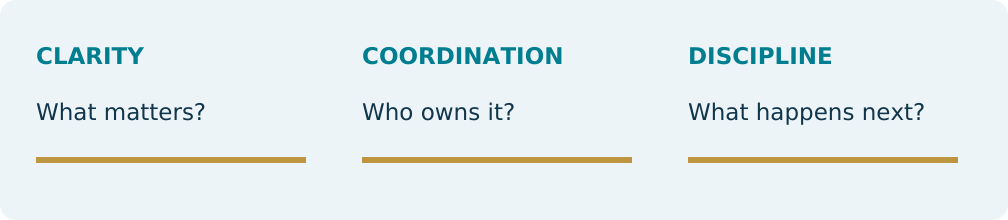
1. Define the destination. What spending, family and business goals does this money support? Which are essential and which can flex?
2. Put risk into dollars. What would a difficult year mean for cash needs and decisions, not just a percentage on a questionnaire?
3. Agree the rules. What would trigger a review, a rebalance or a change? What should happen before a frightened midnight sell decision?
4. Measure what can be measured. Review costs, taxes, progress toward goals and completed planning work. Separate investment results from the quality of the process.
5. Test the relationship. Ask about qualifications, fiduciary responsibilities for the services offered, conflicts, compensation and what is outside the engagement. Compare total costs with services actually delivered. [3]
Your next step
Consider a conversation with qualified financial, tax and legal professionals about where your plan is vulnerable and what can be improved. Bring your questions, account structure, cash needs and business priorities. You do not need a forecast of the next headline to begin.
Follow the arithmetic
Recovery: $1m × (1 − 20%) = $800,000; $800,000 × (1 + 25%) = $1m. Required recovery: $200,000 ÷ $800,000 = 25%. Cash: $800,000 × (1 + 0%) = $800,000. Gap: $1m − $800,000 = $200,000.
Concentration: $1m × 30% = $300,000; × 50% loss = $150,000 (15% of $1m). At 5%: $50,000 × 50% = $25,000 (2.5%).
Costs: $1m × 0.80% = $8,000; × 0.20% = $2,000; difference = $6,000, before advice fees and taxes.
Model: 850 successful paths ÷ 1,000 paths × 100 = 85%. Success depends on the model’s definition and assumptions.
Research and sources
Independent educational commentary. Prepared November 10, 2026. No source chart or proprietary research page is reproduced.