A tax decision
Could a move that lowers this year’s tax bill affect future income, liquidity or the way your business transfers?
GOOD DECISIONS. BETTER TOGETHER.
That you’re doing everything
as well as possible?
You’ve made good decisions along the way.
But are your tax, legal, investment, insurance and business plans working together?


THE GAPS BETWEEN THE PIECES
Your professionals each see a piece. Who sees how they fit?
Could a move that lowers this year’s tax bill affect future income, liquidity or the way your business transfers?
Do withdrawals, account types and risk fit with taxes, insurance and the income your household actually needs?
Do your transition plans line up with legal documents, family expectations and your own next chapter?
These are questions to review together, not a diagnosis or a promised result. Your professionals verify the facts before you act.
THE PAC-MAN PROBLEM
Who’s looking after the biggest piece?
Picture a yellow circle with a small wedge missing. The opening represents familiar conversations about investments, taxes, insurance and personal cash flow.
The rest is your business: the work, the risk, the time—and potentially much of your wealth. It may fund your retirement, yet sit outside the conversations about it.
Good tax, legal, investment and insurance professionals can each do excellent work and still leave gaps between their conversations. You are left connecting the pieces while running your business. War Room helps you bring the whole circle into view.
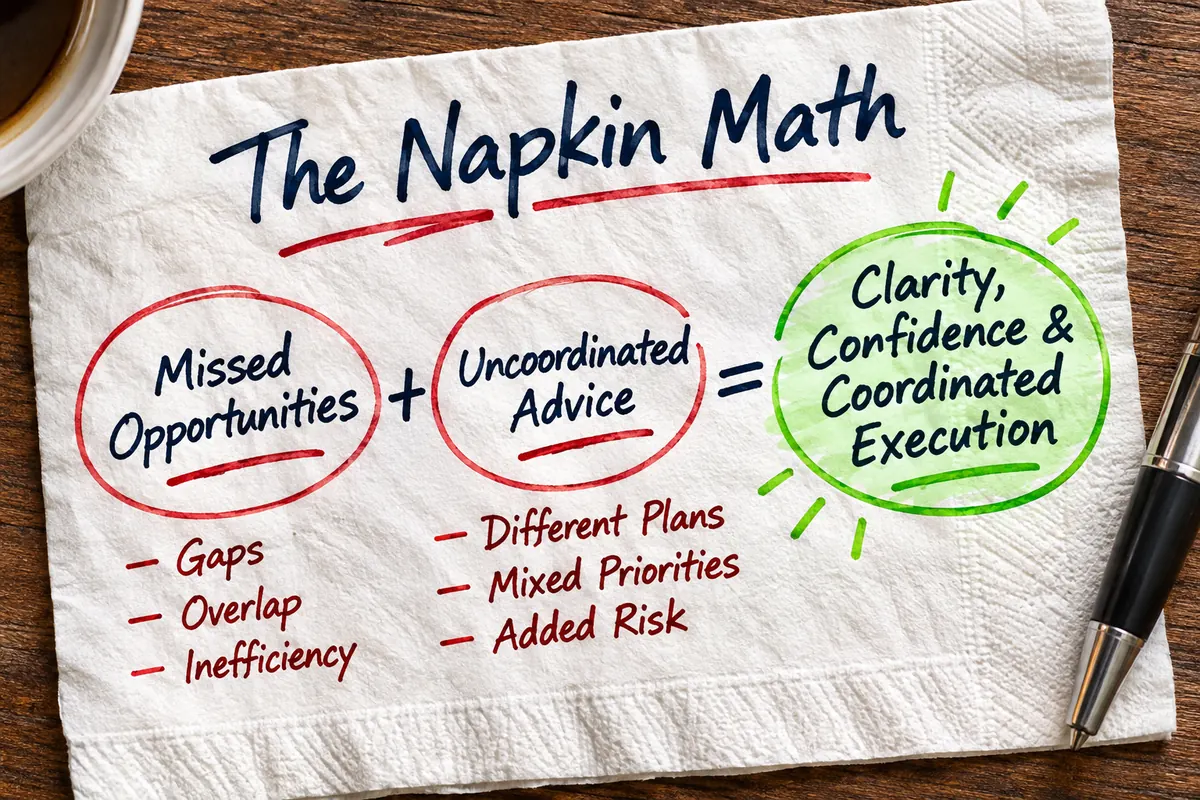
NAPKIN MATH
Good field triage is not a 70-page plan. It is a fast first look at the negatives, the possible upside, and whether the potential difference is large enough to justify deeper analysis.
Open your eyes before you open your wallet.
THE THREE Cs
Start with your life, priorities and existing decisions. Bring the pieces, unknowns and possible gaps into view.
Review assumptions, alternatives and trade-offs with your team. Know what deserves attention and what may already be working.
Decide who does what, in which order, and what needs verification. Professional advice and implementation remain separate engagements.
Q4 / BEFORE WE LOOK AT THE NUMBERS
People → priorities → resources → coordinated action.
Numbers matter, but they cannot define the life you want. These four questions put your people and priorities first—before a calculation starts steering your plan.
Who influences your decisions, and who lives with the outcome? Your spouse, children, business partners and employees may all be part of the answer. Start here because your financial decisions should serve the people counting on you.
Once you know who matters most, ask what you want for them—and for yourself. Freedom, security, time together and promises kept help define your priorities. Without this step, a larger number can distract from the life it is supposed to support.
With people and priorities clear, identify the resources, responsibilities and unknowns: financial assets, real estate, business interests, commitments and obligations. This creates context for the numbers rather than assuming an account balance tells the whole story.
Are your decisions and professionals working toward those priorities together? Define what progress means, what trade-offs you can accept and which next step deserves attention. Now the numbers can help compare possibilities—without replacing your purpose or your team’s judgment.

BY BUSINESS OWNERS. FOR BUSINESS OWNERS.
Business owners don’t have time for long-winded meetings, multiple appointments, and binders collecting more dust than interest.
The right question can make a potential gap apparent before a lengthy planning process begins. Spotting a question is not finishing a plan—or proving a financial outcome. It is a way to decide what deserves your next hour.
IDEAS WORTH TAKING WITH YOU
Keep learning between conversations. Practical perspectives for the business—and the life—you are building.
 War RoomTurn everyday business pressures into clearer priorities and coordinated action. Explore how to build a business that supports the life you want—not just another demanding job.Explore on Amazon →
 SellableUnderstand what can make your business more valuable and transferable. Think beyond today’s income toward future choices, a potential transition and the next chapter you’ve worked to create.Explore on Amazon →
 Retirement X-RayStart with the people and priorities behind your money. Explore the questions that connect retirement income, taxes, protection and legacy—so your next professional conversation starts with a clearer picture.Explore on Amazon →
FIND OUT WHERE YOU STAND
The X-Ray helps you see whether a more coordinated look could benefit you. Not everyone needs comprehensive planning. If you do, wouldn’t you want to know?
Start the X-Ray →